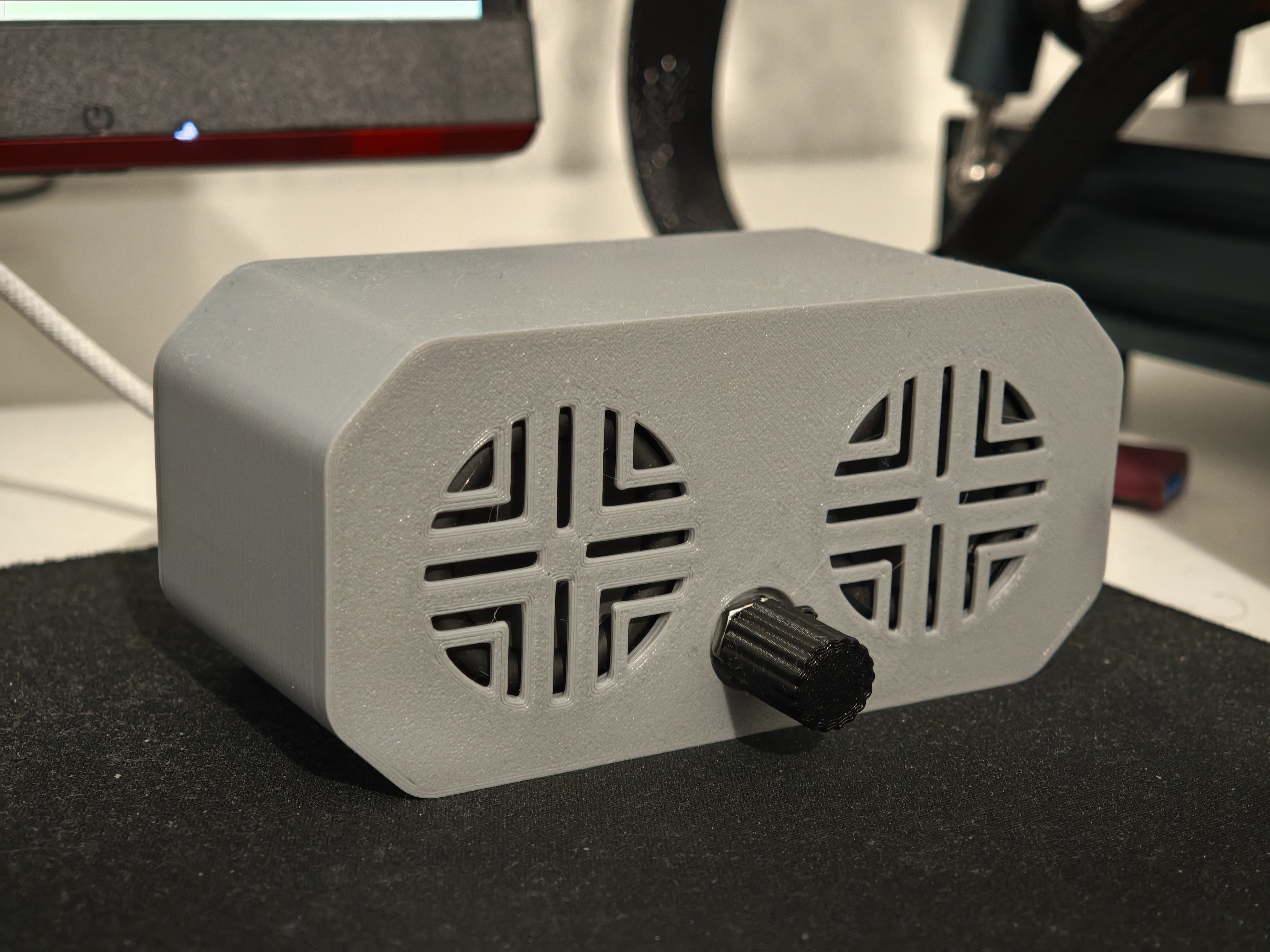
This project is a compact internet radio speaker built around the ESP32-C3. It was designed to solve a very specific problem: reliable, always-available playback of a single radio station without depending on a phone or computer.
The result is a small, purpose-built device that boots directly into playback and is optimized for simplicity, manufacturability, and predictable behavior.
Background and motivation
I have been a long-time listener of a specific radio station from my home country. After moving to Sweden, the only way to listen to it was through a computer or phone, which was inconvenient and easy to forget during work.
Rather than treating this as a software problem, I approached it as an embedded hardware project: a dedicated device that performs one task well and requires no user interaction beyond power and volume control.
Design goals and constraints
From the start, the design was guided by a few non-negotiable constraints:
- Wi-Fi connectivity for internet radio streaming
- Minimal user interface (power + volume only)
- Small PCB footprint
- Good audio quality for near-field listening
- Fully manufacturable using standard PCB assembly services
These constraints informed both the hardware and firmware decisions.
Hardware architecture
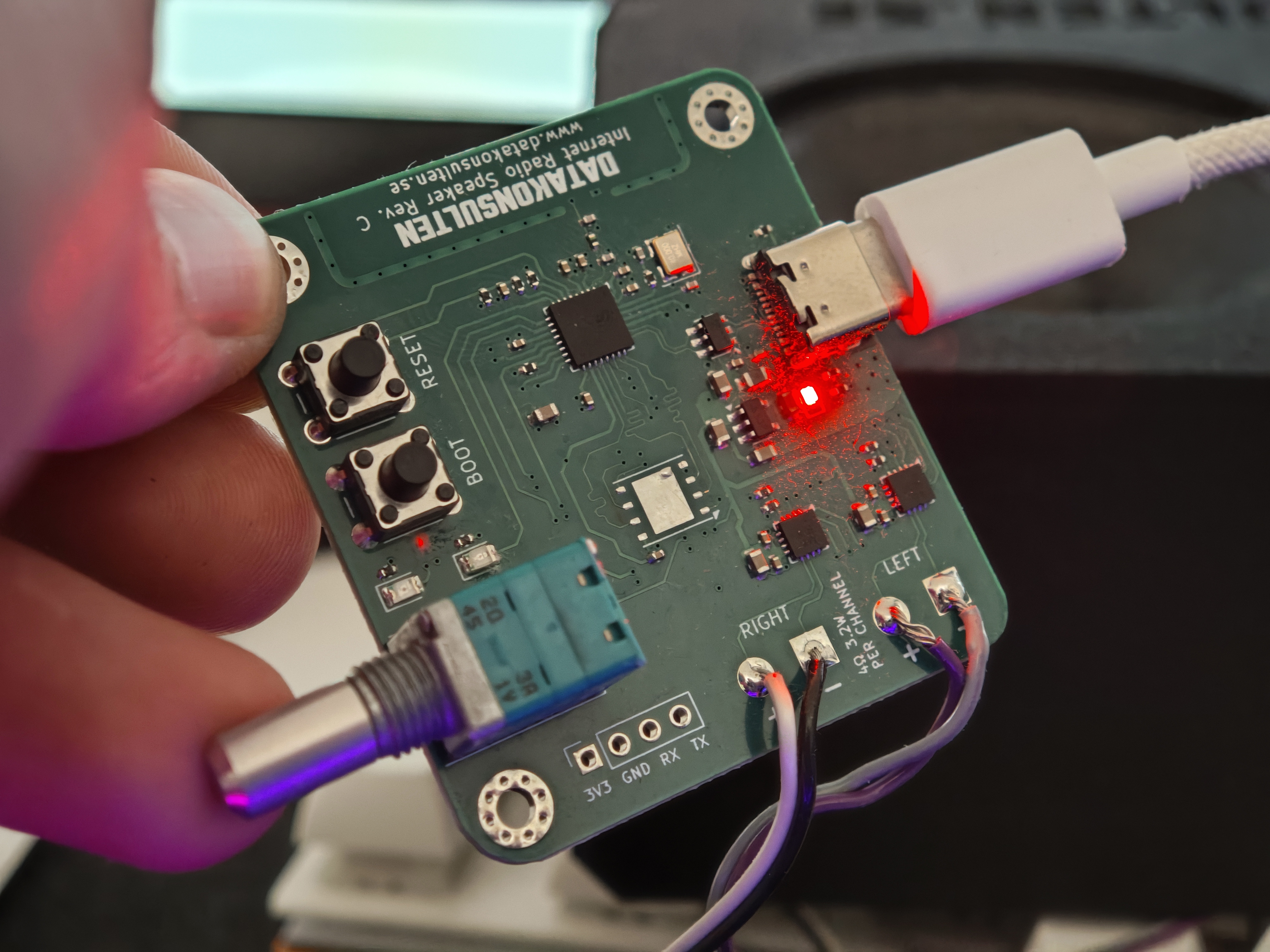
The core of the design is the ESP32-C3, chosen specifically for its single-core architecture and low power consumption. While more powerful ESP32 variants exist, they would have been unnecessary for this use case and would have increased complexity and cost.
Key hardware choices:
- ESP32-C3 module with 32 Mbit flash to reduce external components
- Two MAX98357 I²S class-D audio amplifiers (one per channel)
- Stereo speaker output with sufficient volume for a desktop environment
- Potentiometer with integrated power switch for simple user interaction
- On-board PCB antenna with careful ground and keep-out considerations
Using off-the-shelf I²S amplifiers avoided the need to design a discrete class-D stage, reducing both risk and board size.
Firmware considerations
The firmware was written specifically for this device and is available on GitHub.
Key points:
- Uses the
arduino-audio-toolslibrary by Phil Schatzmann for audio handling - Directly streams internet radio over Wi-Fi
- Optimized for deterministic startup and minimal runtime configuration
A known limitation of the ESP32-C3 is AAC playback performance. Due to the single-core MCU and limited processing headroom, some AAC streams cannot be decoded reliably. This limitation was identified during testing and accepted as a design trade-off.
MP3 streams, however, play reliably and without dropouts.
Manufacturing and cost
The board was designed with manufacturability in mind:
- Highly integrated audio amplifier ICs
- Standard footprints and assembly-friendly layouts
- Impedance-controlled routing for high-speed signals and the on-board Wi-Fi PCB antenna
The most significant cost drivers are the two audio amplifiers, but their use significantly reduces development time and PCB complexity compared to a custom amplifier design.
Open-source approach
Both the hardware design files and firmware are open source and available on GitHub. The project is structured to be easy to modify, extend, or adapt to other radio streams or use cases.
Key takeaways
This project reinforced several practical lessons:
- Wireless performance is highly sensitive to PCB layout and antenna placement
- Simpler architectures often lead to more reliable products
- Purpose-built devices outperform general-purpose solutions for focused tasks
Overall, this was a valuable exercise in designing a constrained, real-world embedded system from concept to functional hardware.